Introduction: The Indian Dividend Landscape
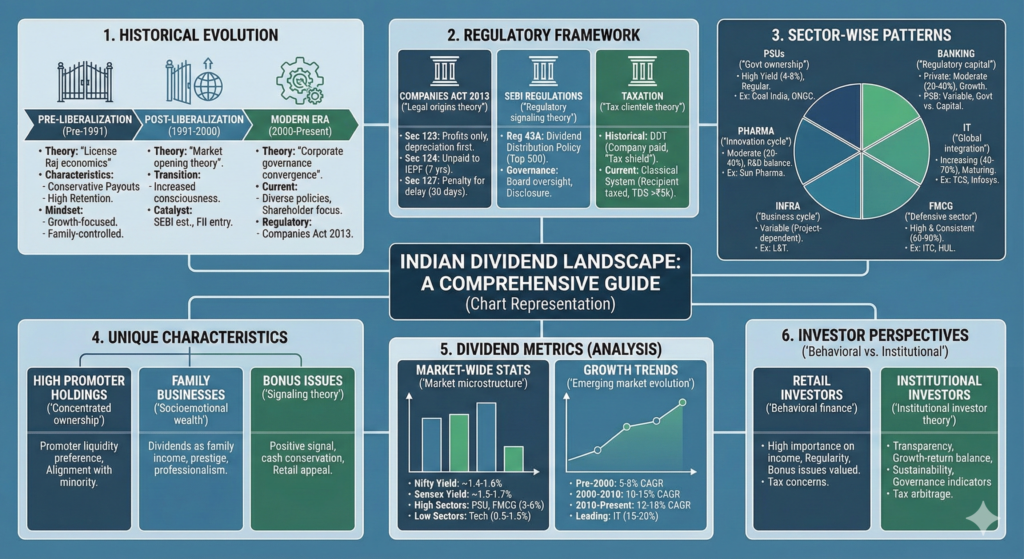
India’s dividend culture has evolved significantly over the decades, reflecting the country’s economic transformation, regulatory changes, and corporate governance improvements. From traditionally conservative payout policies to increasingly shareholder-friendly approaches, Indian companies offer unique insights into dividend dynamics in an emerging market context.
📜 Historical Evolution of Dividend Culture in India
Pre-Liberalization Era (Pre-1991)
Theoretical Insight: ‘License Raj economics’ created protected markets with limited competition, allowing companies to retain earnings for expansion in a capital-scarce economy, resulting in conservative dividend policies.
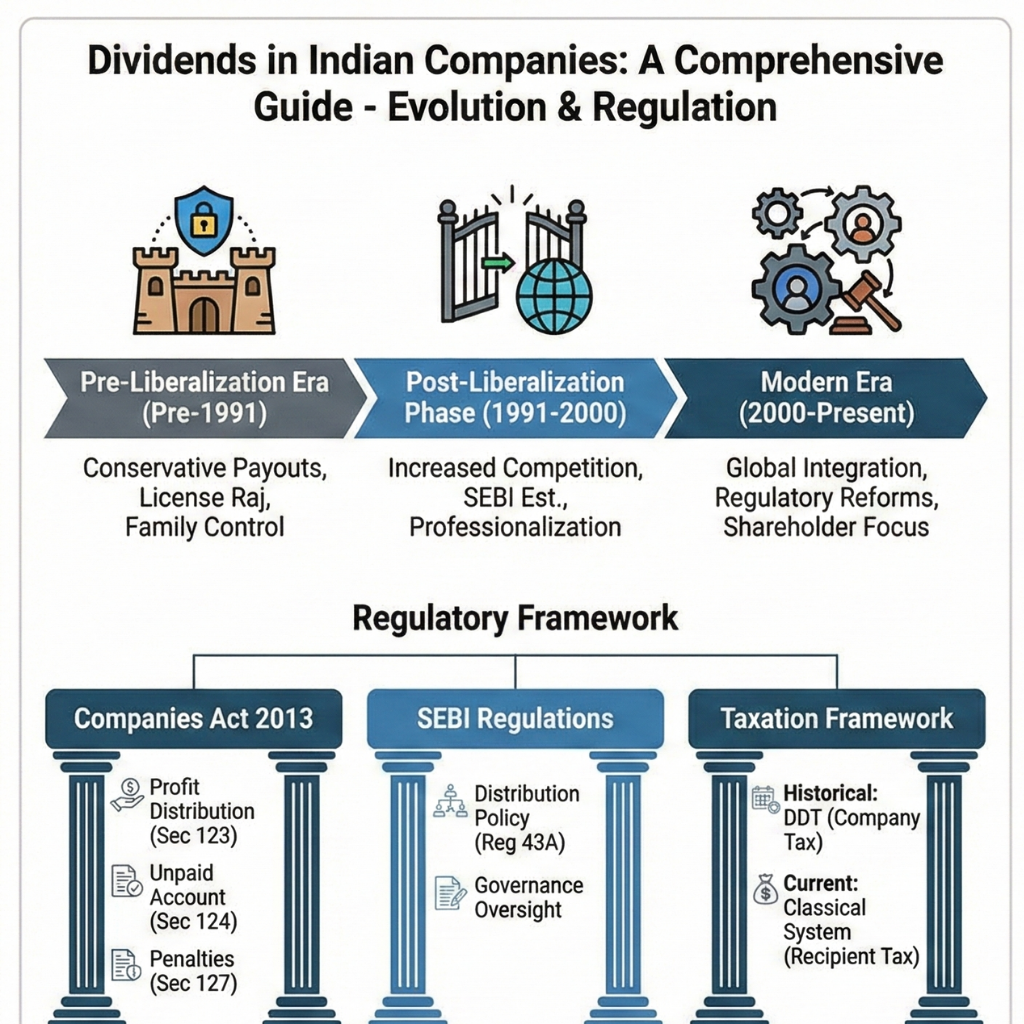
Characteristics: Low dividend payouts, high retention ratios
Regulatory Environment: Strict capital controls, limited foreign investment
Corporate Mindset: Growth-focused, family-controlled businesses prioritizing expansion
Examples: Traditional family businesses like Tata, Birla groups
Post-Liberalization Phase (1991-2000)
Theoretical Insight: ‘Market opening theory’ suggests that increased competition and access to global capital markets forced Indian companies to adopt more shareholder-friendly policies to attract foreign investment.
Transition: Gradual increase in dividend consciousness
Catalyst: SEBI establishment (1992), foreign institutional investors entry
Change: Professionalization of management, improved governance
Impact: Beginning of regular dividend cultures in professionally managed companies
Modern Era (2000-Present)
Theoretical Insight: ‘Corporate governance convergence theory’ explains how global integration and regulatory reforms (Clause 49, Companies Act 2013) have aligned Indian dividend practices with international standards.
Current State: Diverse dividend policies across sectors
Regulatory Framework: Companies Act 2013, SEBI LODR regulations
Investor Expectations: Increasing demand for shareholder returns
Trend: Balance between growth reinvestment and dividend distribution
🏛️ Regulatory Framework Governing Indian Dividends
Companies Act 2013 Provisions
Theoretical Basis: ‘Legal origins theory’ applied to India shows how common law heritage provides strong minority shareholder protection, mandating equitable distribution of profits.
Section 123: Declaration of Dividend
Only out of profits for the year or previous years
Depreciation must be provided before dividend declaration
Transfer to reserves may be required in certain cases
Section 124: Unpaid Dividend Account
Unclaimed dividends for 7 years transferred to Investor Education and Protection Fund
Ensures proper accounting and prevents misuse
Section 127: Penalty for Failure to Distribute
Directors liable if dividend declared but not paid within 30 days
Demonstrates legal seriousness of dividend commitments
SEBI Regulations
Theoretical Insight: ‘Regulatory signaling theory’ suggests that SEBI’s dividend distribution guidelines serve as corporate governance markers, influencing investor perceptions and company valuations.
Dividend Distribution Policy (Regulation 43A)
Top 500 listed companies must formulate dividend policy
Policy must be disclosed on website and in annual report
Parameters must include circumstances for non-payment
Corporate Governance Requirements
Board and audit committee oversight of dividend decisions
Disclosure of utilization of retained earnings
Transparency in related-party transactions affecting profits
Taxation Framework
Theoretical Perspective: ‘Tax clientele theory’ explains how India’s shifting dividend taxation regime (from DDT to classical system) has altered investor preferences and corporate payout decisions.
Historical: Dividend Distribution Tax (DDT)
Company paid tax on distributed dividends (until 2020)
Created “tax shield” effect for shareholders
Simplified tax collection but distorted payout decisions
Current: Classical System (2020 onward)
Dividends taxed in hands of recipients
TDS applicable above ₹5,000 threshold
Aligns with global practices, increases transparency
📊 Sector-Wise Dividend Patterns in India
1. Public Sector Undertakings (PSUs)
Theoretical Insight: ‘Government ownership theory’ suggests PSU dividends serve dual purposes: providing shareholder returns to government and functioning as quasi-fiscal tools for resource mobilization.
Characteristics:
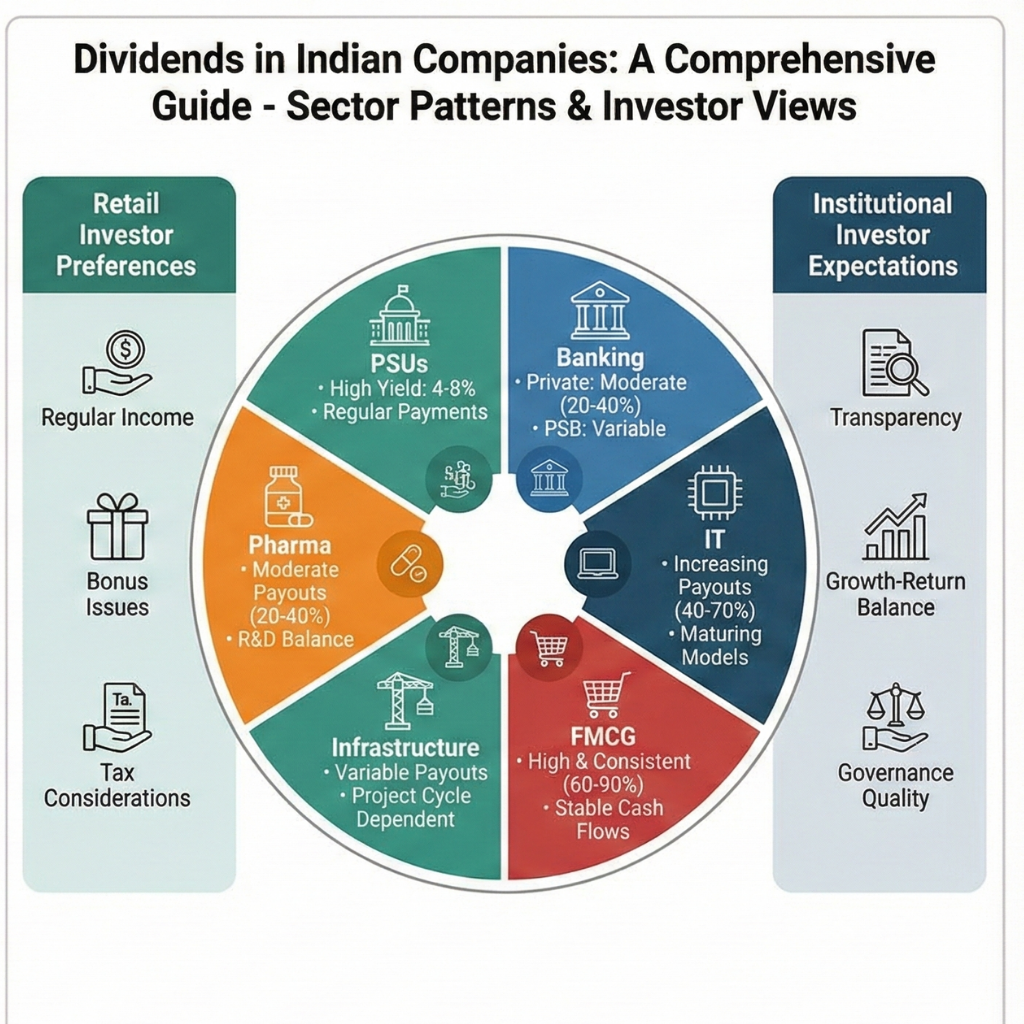
High Dividend Yield: Often 4-8% range
Regular Payments: Government pressure for consistent dividends
Examples: Coal India (5-7%), ONGC (4-6%), Power Grid (4-5%)
Rationale: Cash-rich operations, limited growth capital requirements
Unique Aspect: Dividends supplement government revenues
2. Banking & Financial Services
Theoretical Insight: ‘Regulatory capital theory’ explains how RBI’s capital adequacy requirements (Basel norms) create cyclical dividend patterns, with payouts increasing during strong capital position periods.
Private Banks:
Moderate Payouts: 20-40% typically
Growth Focus: Reinvestment for expansion
Examples: HDFC Bank (30-35%), ICICI Bank (20-25%)
Constraints: Regulatory capital requirements, NPA cycles
Public Sector Banks:
Variable Payouts: Government dividend expectations vs. capital needs
Examples: SBI (25-40% depending on performance)
Challenges: Balancing regulatory capital, government expectations, growth needs
3. Information Technology
Theoretical Insight: ‘Global integration theory’ shows how Indian IT companies’ dividend policies reflect their position in global value chains, balancing offshore cash reserves with domestic shareholder expectations.*
Characteristics:
Increasing Payouts: Maturing business models
Payout Ratios: 40-70% range
Examples: TCS (80-100%), Infosys (70-85%), Wipro (40-50%)
Trend: Transition from growth to value phase
Unique: Large offshore cash balances affecting dividend decisions
4. Fast Moving Consumer Goods (FMCG)
Theoretical Insight: ‘Defensive sector theory’ explains FMCG’s high dividend consistency through stable demand patterns, pricing power, and limited cyclicality, creating reliable cash flows for distribution.
Characteristics:
High & Consistent: Regular dividend increases
Payout Ratios: 60-90% typically
Examples: ITC (80-85%), HUL (90-95%), Nestle India (70-80%)
Rationale: Stable cash flows, mature markets, brand dominance
Quality Marker: Dividend consistency reflects business stability
5. Infrastructure & Capital Goods
Theoretical Insight: ‘Business cycle theory’ applied to infrastructure explains variable dividend patterns tied to project cycles, regulatory approvals, and capital expenditure requirements.
Characteristics:
Variable Payouts: Project cycle dependent
Examples: L&T (30-50%), UltraTech Cement (20-40%)
Challenges: Large working capital needs, long gestation projects
Pattern: Lower during expansion phases, higher during maturity
6. Pharmaceuticals
Theoretical Insight: ‘Innovation cycle theory’ shows how R&D intensity and patent cliffs create dividend policy tensions between funding future innovation and rewarding current shareholders.
Characteristics:
Moderate Payouts: 20-40% range
Examples: Sun Pharma (20-30%), Dr Reddy’s (20-25%)
Balance: R&D funding needs vs. shareholder returns
Trend: Increasing as businesses mature
💰 Unique Indian Dividend Characteristics
High Promoter Holdings Impact
Theoretical Insight: ‘Concentrated ownership’ theory explains how high promoter stakes in Indian companies create dividend preferences aligned with promoter needs, including tax planning and liquidity requirements.
Effects:
Promoters often prefer dividends over buybacks for personal liquidity
Dividend policies may reflect promoter cash flow needs
Alignment between promoter and minority shareholder interests in dividend expectations
Dividend Culture in Family Businesses
Theoretical Insight: ‘Socioemotional wealth theory’ applied to Indian family businesses shows how dividends serve both financial and non-financial purposes, including family prestige, intergenerational wealth transfer, and reputation management.
Patterns:
Traditional conservative approach giving way to regular payouts
Dividends as family income source while maintaining control
Increasing professionalism in dividend decisions
Bonus Issues Tradition
Theoretical Insight: Signaling theory in Indian context suggests bonus issues serve as positive signals about future prospects while conserving cash, particularly appealing in a market with strong retail investor participation.
Unique Aspect:
Indian companies frequently issue bonus shares alongside dividends
Psychological appeal to retail investors
Combines reward with capital base expansion
📈 Dividend Metrics: Indian Context Analysis
Market-Wide Statistics
Theoretical Basis: ‘Market microstructure’ theory applied to dividends examines how India’s unique investor composition (high retail participation) affects dividend yield patterns and market reactions to dividend announcements.*
Current Averages:
Nifty 50 Dividend Yield: ~1.4-1.6%
Sensex Dividend Yield: ~1.5-1.7%
Historical Range: 1.2-2.5% depending on market cycles
Sector Variations:
Highest Yields: PSUs, FMCG, Utilities (3-6%)
Lowest Yields: Technology, Consumer Discretionary (0.5-1.5%)
Dividend Growth Trends
Theoretical Perspective: ‘Emerging market dividend evolution theory’ tracks how Indian companies’ dividend growth rates reflect economic development stages and corporate maturity progression.
Historical Growth:
Pre-2000: 5-8% CAGR
2000-2010: 10-15% CAGR
2010-Present: 12-18% CAGR (with sector variations)
Leading Sectors:
IT Services: Highest dividend growth (15-20% CAGR)
Private Banks: Moderate growth (10-15% CAGR)
FMCG: Steady growth (8-12% CAGR)
🎯 Investor Perspectives: Indian Market Realities
Retail Investor Preferences
Theoretical Insight: ‘Behavioral finance theory’ explains Indian retail investors’ strong dividend preference through mental accounting, income illusion, and cultural factors favoring regular returns.
Characteristics:
High importance placed on dividend income
Preference for regular, predictable payments
Bonus issues particularly valued
Tax considerations increasingly important
Institutional Investor Expectations
Theoretical Framework: ‘Institutional investor theory’ shows how FIIs and domestic institutions use dividend policies as governance indicators, preferring companies with clear, consistent payout frameworks.
Preferences:
Transparency in dividend policy
Balance between growth and returns
Sustainability of payouts
Governance quality indicators
Tax Implications for Different Investors
Theoretical Application: ‘Tax arbitrage theory’ explains how India’s dividend taxation changes have created shifting advantages for different investor categories, influencing portfolio decisions.
Current Tax Structure:
Individuals: Taxable as income, TDS above ₹5,000
Corporate Investors: Dividend income taxable, but deduction available
Foreign Investors: Subject to treaty benefits, typically lower rates
Comparison: Dividends vs. capital gains tax efficiency