In today’s modern age, we pull mobile phones out of our pockets to snap a photo whenever and wherever we want. Whether it’s huge cameras at weddings or telescopes in space, these devices have become such a normal part of our lives that we hardly ever stop to think about how it all began. Have you ever wondered who thought of the world’s very first camera and how it was made? There is a name in the pages of history that is often forgotten, but the reality is that the world of modern photography and science is indebted to this very person. That name is the great 11th-century scientist Ibn al-Haytham, also known in the West as Alhazen.
Who Was Ibn al-Haytham?
This story begins about a thousand years ago, around 965 AD, when Ibn al-Haytham was born in the city of Basra, Iraq. That era was the ‘Golden Age of Islam,’ a time when science, art, and philosophy were at their peak. Ibn al-Haytham was very curious from childhood. He never accepted anything just because a great person said it; instead, he demanded proof for everything. This very habit eventually made him the world’s “First True Scientist.”
The Nile River and a Punishment That Became a Blessing
The most important turning point in his life came when the ruler of Egypt (the Caliph) at the time summoned him for a task. The Caliph wanted Ibn al-Haytham to find a way to control the flooding of the Nile River. When Ibn al-Haytham went there and surveyed the site, he realized that with the technology of that time, this task was impossible. However, the problem was that the Caliph had a very short temper. To save his life, Ibn al-Haytham feigned madness. Consequently, instead of executing him, the Caliph placed him under house arrest in his own home in Cairo. He had to live alone in a room, cut off from the outside world, for many years.
This was the time when history was made. In the eyes of the world, he was a prisoner, but in reality, he was sitting in a laboratory where a new chapter of Optics was about to begin.

Figure 1: Ibn al-Haytham in his dark room in Cairo, observing the light coming through a small hole in the window.
The Magic of the Dark Room: Discovery of the Camera Obscura
While Ibn al-Haytham was in confinement, his room remained completely dark. One day, around noon, he noticed a very tiny hole (pinhole) in his window shutter. The sun was shining brightly outside, and a thin ray of light was entering the room through that small hole.
Then, his eyes fell upon the opposite wall, and he was stunned. The light passing through that small hole had created an image of the outside scene on the wall. The trees, buildings, and people outside were all visible on the wall, but there was one strange thing—the entire image was inverted (upside down). The top of the tree appeared at the bottom, and the bottom appeared at the top.
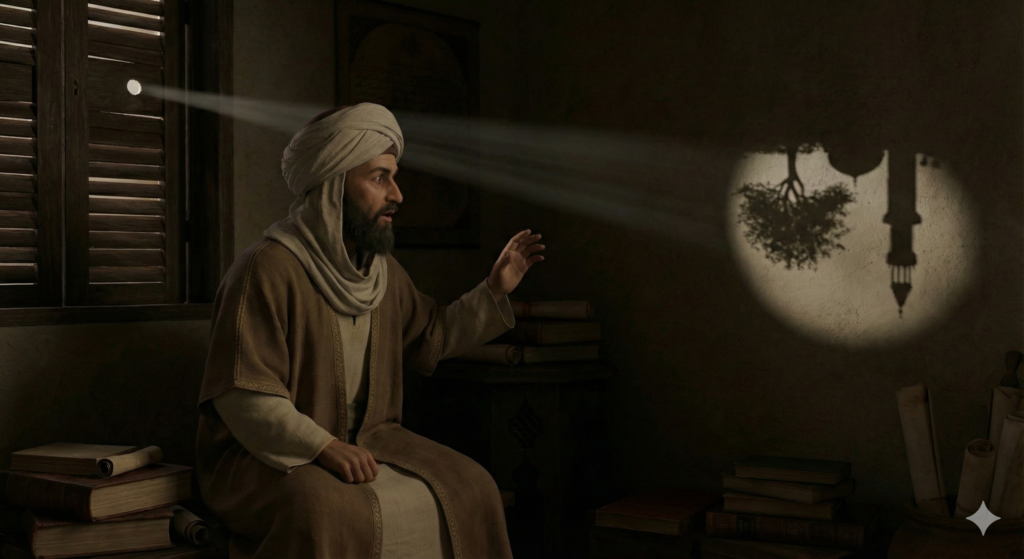
Figure 2: Ibn al-Haytham marveling at the inverted image formed on the wall, which was the moment of his great discovery.
An ordinary person might have dismissed this as a miracle, but Ibn al-Haytham was a scientist. He contemplated this deeply and understood that light always travels in a straight line. When light rays from the top and bottom of an object pass through a very small hole, they cross each other inside that hole. This is why the ray coming from the top exits the hole and goes down, and the ray coming from the bottom goes up. This is precisely why the image on the wall was formed upside down.
He called the dark room he used for this experiment ‘Qamara’ in Arabic, which means a ‘dark or private chamber.’ When his books reached Europe and were translated into Latin, this very word ‘Qamara’ became ‘Camera Obscura’ (Dark Chamber). And the word ‘Camera’ that we use today is derived directly from Ibn al-Haytham’s Arabic word ‘Qamara.’
The Mystery of Our Eyes: How Do We See?
Ibn al-Haytham did not just create the camera; he also explained to humanity how we actually see. Before him, great Greek scholars like Plato and Euclid believed that light beams emitted from our eyes like a torch, touched objects, and that is how we saw things.
In his famous book, ‘Kitab al-Manazir’ (Book of Optics), Ibn al-Haytham proved this centuries-old belief wrong. He demonstrated with mathematics and evidence that light does not emit from our eyes; rather, it falls on objects from an external source (like the sun or a lamp), reflects off them, and then enters our eyes. Only then is an image formed in our brain. This is the same principle that modern science accepts today.

Figure 3: Ibn al-Haytham documenting his discovery, drawing a diagram of how light rays pass through a small hole to form an inverted image.
A Legacy That Lives On
The principle of the ‘Pinhole Camera’ discovered by Ibn al-Haytham became the foundation upon which photographic cameras were built in the 19th century. The only difference was that Ibn al-Haytham viewed the image on a wall, while later scientists learned to capture that image on film reels and sensors. Furthermore, he also worked on curved glass pieces (lenses), explaining how things could be magnified. His research paved the way for the invention of eyeglasses, microscopes, and telescopes.
So, the next time you take a selfie with your phone or capture a beautiful view, take a moment to remember that Muslim scientist who, even while imprisoned in a dark room, taught the world the correct way to see light. Ibn al-Haytham’s story teaches us that with curiosity and the power of thought, a human being can find new paths even in the darkness.