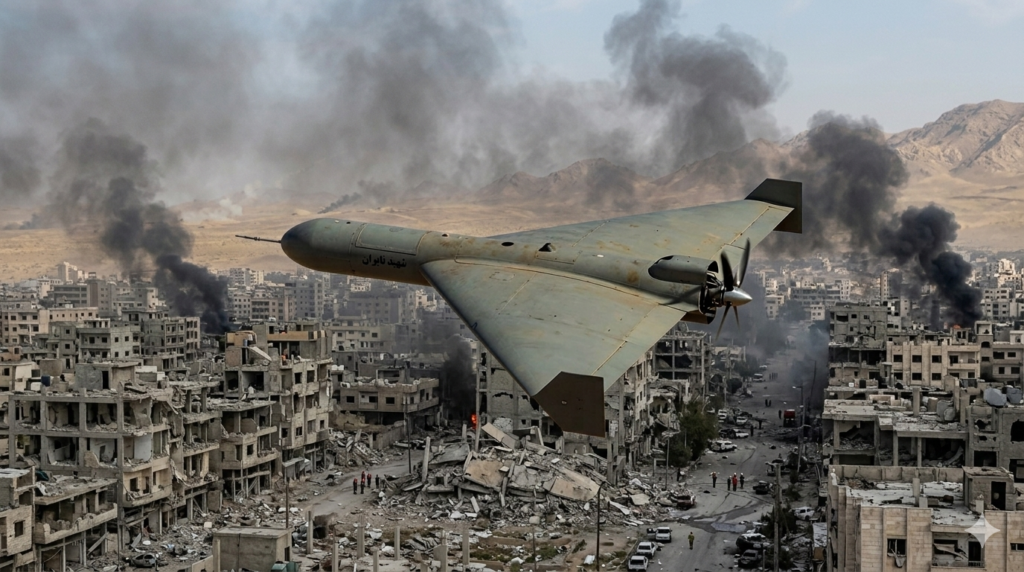
The Shahid 136, also known as Shahed 136 or Geran-2, is an Iranian one-way attack drone designed for long-range kamikaze strikes. Produced by HESA and Shahed Aviation Industries, it has gained notoriety in modern conflicts for its low cost and swarm tactics.
Design Features
The drone features a cropped delta-wing shape with a central fuselage blending into the wings and stabilizing rudders at the tips. It measures 3.5 meters long with a 2.5-meter wingspan and weighs about 200 kg, powered by a rear-mounted Mado MD-550 piston engine—a reverse-engineered German Limbach L550E—driving a two-bladed pusher propeller. Launch occurs from portable truck-mounted rails with initial rocket assistance before the engine takes over.
Specifications
Key specs include a top speed over 185 km/h, altitude range of 60-4,000 meters, and endurance up to 11.5 hours.
| Parameter | Details |
| Length | 3.5 m |
| Wingspan | 2.5 m |
| Weight | 200 kg (max takeoff ~186 kg) |
| Payload | 30-50 kg warhead (up to 40 kg explosive) |
| Range | 970-2,500 km |
| Speed | 185 km/h max |
| Engine | MD-550 piston, 50 hp |
Operational Use
Deployed by Iran and Russia (as Geran-2), it targets infrastructure via inertial navigation and GPS, often in swarms to overwhelm defenses. Notable uses include Russia’s Ukraine campaign and recent Middle East strikes on Bahrain, Kuwait, and UAE. Its affordability—far cheaper than interceptors—poses challenges for air defenses.
Strategic Impact
The Shahid 136 democratizes long-range precision strikes, shifting warfare toward cheap, mass-produced loitering munitions. It has prompted counter-developments like U.S. Replicator initiatives and European interceptors, while copies emerge globally. Low production costs enable saturation attacks, reshaping budgets and tactics.