Honey isn’t just a pantry staple or a simple sweetener; it’s a biological marvel. Produced by bees from the nectar of flowers, this viscous “liquid gold” has been used for over 8,000 years, bridging the worlds of staple food and traditional medicine. In this comprehensive guide, we explore why honey deserves its title as nature’s ultimate superfood.
Honey begins its journey far from the jar. It starts as clear floral nectar. The magic happens when the honeybee (genus Apis) collects this nectar, breaking down complex sugars via enzymes in its honey stomach. The mixture is then deposited into the hexagonal cells of the honeycomb.
To truly appreciate honey, we must first appreciate the harvest. The process starts when the honeycomb is perfectly sealed.
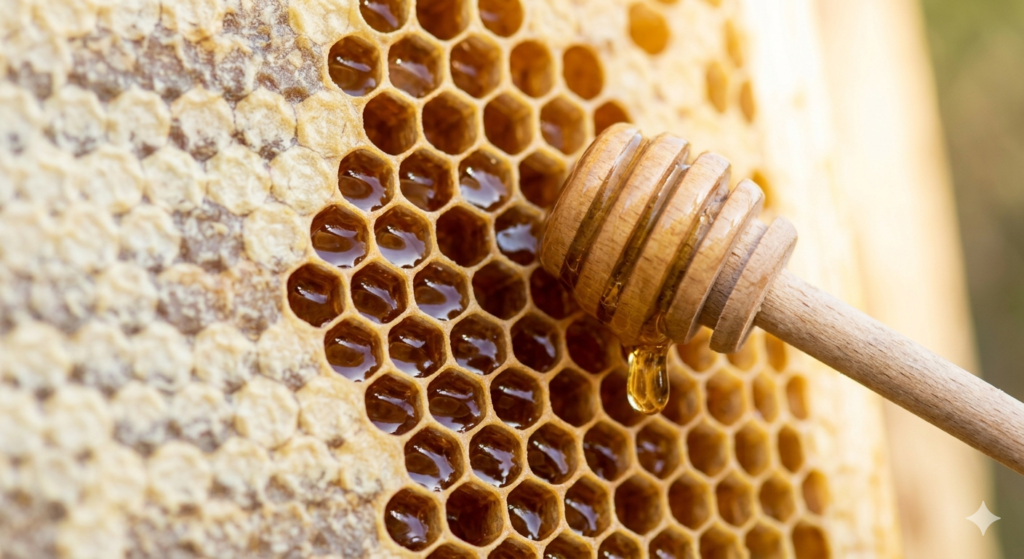
This macro photograph captures the essence of raw honey. The image focuses on the intricate, hexagonal geometry of fresh honeycomb. Some cells are tightly capped with pale wax, while others (left and center) glisten with thick, deep amber honey, catching the light like a jewel. The natural viscosity of the substance is emphasized by the single, heavy bead swelling on the tip of the wooden honey dipper resting nearby. The soft-focus background of golden light reinforces the purity of the hive environment.
What’s the difference? Raw honey (like that shown above) is alkaline-forming and contains amylase, an enzyme that helps digest starchy foods. Commercial, pasteurized honey, however, is often heated, which destroys these beneficial enzymes.
The composition of honey is fascinating. While it is primarily fructose and glucose (carbohydrates), its true value lies in the minor components—the antioxidants, minerals, and bioactive compounds.
We can incorporate these benefits into our daily routines, especially when we are feeling run down. Honey pairs perfectly with simple, traditional ingredients to create a calming wellness ritual.
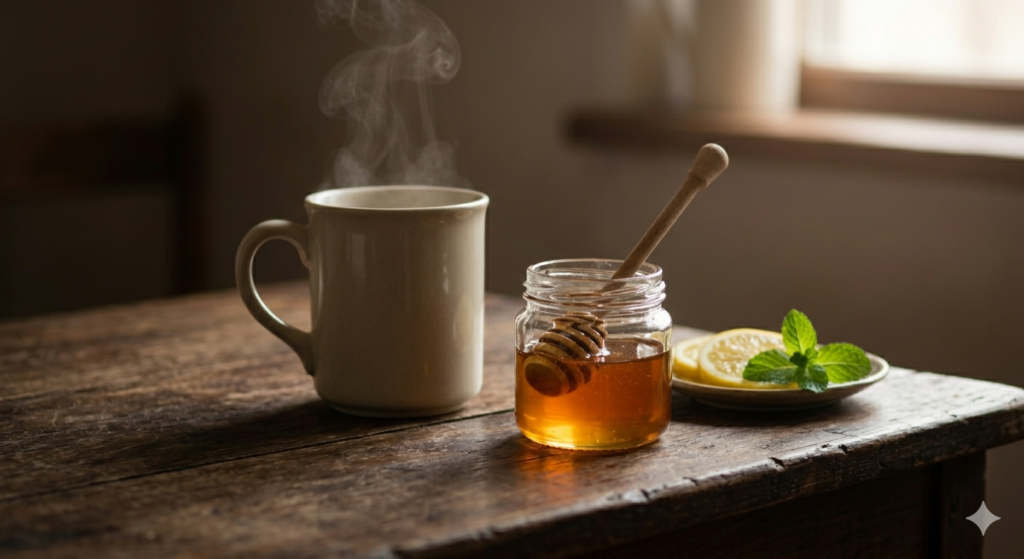
This image shifts the focus from the source (Image 1) to the ritual of use. Here, the raw honey—the same deep amber, glistening substance seen previously—is presented in a small glass jar on a dark, worn wooden table. A classic ceramic mug emits gentle steam, ready for a soothing brew. The lighting is soft and warm, coming from the right, highlighting the textures of the honey, the fresh lemon slices, and the sprig of mint. The entire scene is designed to evoke a cozy, inviting, and medicinal atmosphere.
Important Safety Note: Honey should never be given to infants under one year old due to the risk of botulism spores, which their developing digestive systems cannot handle.
Honey’s flavor profile is as diverse as the flowers the bees visit. It ranges from the very light and mild (like Orange Blossom) to the dark, robust, and earthy (like Buckwheat). This makes it incredibly versatile in the kitchen.
Honey’s unique property of being hygroscopic (meaning it absorbs moisture from the air) makes it excellent for baking, as it helps cakes and breads retain moisture and stay fresh longer.
While honey is often used as a direct sweetener in tea, its most potent culinary application is balance. It can cut through acidity, mellow heat, or glaze savory dishes.
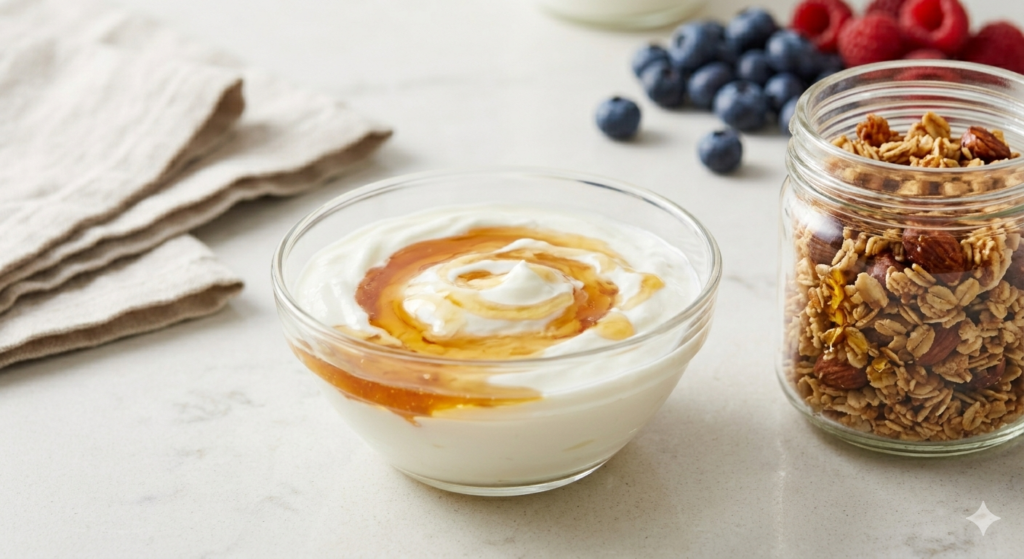
This image provides a bright, clean culinary application. Moving away from the rustic, medicinal setting (Image 2), we are in a modern, light-filled kitchen. A delicate glass bowl of thick Greek yogurt is the center of attention. A prominent, glistening swirl of the deep amber honey (connecting visually back to the source in Image 1 and the jar in Image 2) coats the surface. The scene is healthy, vibrant, and appetizing. A clear jar of granola and fresh berries provides texture, bathed in the natural morning light.
Not all honey is created equal. The flavor, color, and medicinal value depend entirely on the floral source.
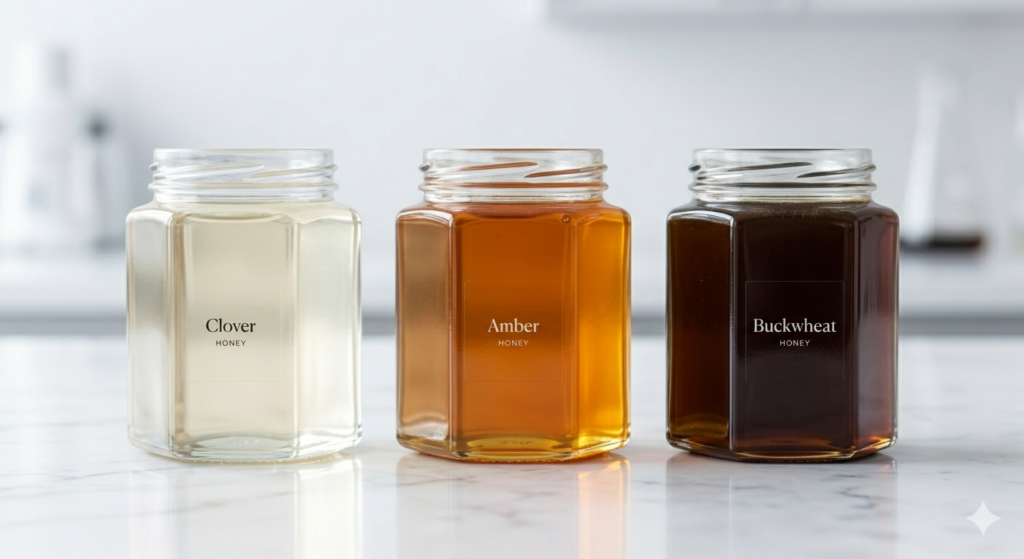
We can visually observe how the source dictates the final product. Different honeys have dramatically different colors and textures.
This minimalist studio photograph beautifully illustrates the diversity of honey. Three identical hexagonal glass jars (a nod to the structure seen in Image 1) are lined up on a reflective white marble surface. The lighting is diffused and bright, making the honey catch and refract light like a prism. Each jar holds a distinct variety, ranging from very pale and clear (left) to the classic deep amber honey we have traced (center), to a very dark, robust brown (right). The clean, modern background hints at a lab setting, emphasizing the scientific analysis of botanical purity.
This image allows us to compare the physical properties side-by-side, visually confirming that the environment and floral source are responsible for the complex vaust brown (right). The clean, modern background hints at a lab setting, emphasizing the scientific analysis of botanical purity.
This image allows us to compare the physical properties side-by-side, visually confirming that the environment and floral source are responsible for the complex variations.