
By MOHD TALHA
Introduction
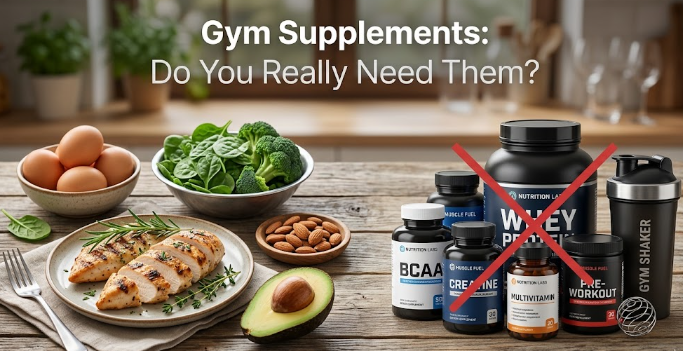
If you go to a gym, you’ve probably seen people carrying protein shakers, taking pills, or mixing powders. Walk into any gym, and you’ll find at least half the members consuming some form of dietary supplement.
But here’s the real question – Do you really need supplements? Or is it just a trend driven by misinformation?
A scientific study conducted in Brazil and published in a peer-reviewed journal tried to answer exactly this. The study, titled “Factors associated with dietary supplement use by people who exercise at gyms”, surveyed 723 regular gym-goers and found some shocking results.https://notebooklm.google.com/notebook/ad488b9c-1322-4718-baf0-0cb51c86b45a
Let’s break it down.
Key Findings of the Study (At a Glance)
| Parameter | Result |
|---|---|
| Total participants | 723 gym members |
| Supplement users | 64.7% (almost 2 out of 3 people) |
| Most common supplements | Protein & amino acids (12%) |
| Second most common | Micronutrients (4.6%) |
| Multiple supplements together | 34.4% of users |
| Who recommended supplements? | Friends (17.8%), Self (15.8%), Trainers (17.3%) |
| Dietitians recommended | Only 10.3% |
Shocking Reality: Most Supplement Users Don’t Need Them
The study found that people who used supplements the most were not the ones with poor diets. In fact, most users rated their own diet as “good” or “excellent.”
So why were they taking supplements?
The main reasons were:
1. Self-Perception of Body Weight
People who felt they were “below ideal weight” were the biggest supplement users – 82.5% of them used supplements. Their goal was clearly to gain muscle mass, not to fix a nutrient deficiency.
2. Training Intensity
Those who rated their workout as moderate or intense were far more likely to use supplements. Only 40.9% of “mild” exercisers used supplements, compared to 79.9% of “intense” exercisers.
3. Gym Experience
- New members (less than 1 month) – Only 45% used supplements
- Experienced members (more than 1 year) – 73.9% used supplements
Longer time in the gym environment = more pressure/influence to take supplements.
4. Smoking
Smokers had the highest supplement use – 88%. This is likely because smokers are advised to take Vitamin C to counter free radical damage.
The Biggest Problem: No Professional Guidance
Here’s where it gets dangerous.
The study asked participants: Who recommended your supplements?
- Friends/acquaintances – 17.8%
- Self-prescription – 15.8%
- Gym trainers – 17.3%
- Dietitians – Only 10.3%
Read that again. Only 1 out of 10 supplement users consulted a qualified nutrition professional.
Most people relied on friends, trainers (who are not qualified to prescribe supplements), or simply decided themselves.
Which Supplements Were Most Popular?
| Supplement Type | Percentage of Users |
|---|---|
| Protein & amino acids | 12.0% |
| Micronutrients (vitamins/minerals) | 4.6% |
| Carbohydrate-rich | 3.5% |
| Thermogenics | 2.6% |
| Creatine | 1.5% |
| Herbal agents | 2.9% |
| 2 or more types together | 34.4% |
What Does Science Say About Supplements?
According to the same study and multiple sports nutrition experts:
“With rare exceptions, supplements are unnecessary when a person’s diet is quantitatively and qualitatively adequate and accompanied by appropriate fluid intake.”
That means – if you eat a balanced diet, you likely don’t need protein powders, BCAAs, or multivitamins. Your body gets everything from real food.
Supplements are only justified when:
- Your diet is genuinely deficient in something
- You have a medical condition
- You’re an elite athlete with very high nutrient demands
For an average person exercising 3-5 times a week – whole food is enough.
Risks of Unsupervised Supplement Use
Taking supplements without professional guidance can lead to:
- Kidney & liver stress – Excess protein is hard on kidneys
- Nutrient imbalances – Too much of one vitamin can block others
- Wasted money – Most supplements pass out in urine
- Contamination – Many supplements are not FDA/FSSC verified
- False sense of security – “I took protein so I can eat junk”
What Should You Do?
Before buying any supplement, ask yourself:
- Is my diet truly lacking? (Keep a food diary for 3 days)
- Have I consulted a qualified dietitian? (Not gym trainer, not friend)
- Do I really need this, or am I influenced by social media/gym culture?
- Is this supplement scientifically proven? (Not just marketing claims)
Safe Approach:
- Focus on whole foods first – eggs, chicken, fish, dairy, legumes, nuts, vegetables
- Stay hydrated – water is the most underrated supplement
- If you still feel the need, consult a Registered Dietitian (RDN)
- Never take multiple supplements without professional guidance
Final Verdict
This Brazilian study clearly shows that most gym-goers are taking supplements without any real need or professional advice. They’re motivated by body image issues, gym peer pressure, and misinformation.
Supplements are not magic. They won’t transform your body if your diet and training are poor. And taking them without need is just wasting money – and possibly harming your health.
Remember: A protein powder can never replace a home-cooked meal. And a pill can never replace real vegetables.
References
This article is based on the following peer-reviewed study:
Hortegal EV, Cabral NAI, Veloso HJF. Factors associated with dietary supplement use by people who exercise at gyms. Centro Universitario do Maranhao, Sao Luis, Brazil. 2011-2012.
DOI:10.1590/S0034-8910.2015049005912
About the Author
MOHD TALHA is committed to providing science-backed health and fitness information. We don’t promote supplements unless proven necessary. Always consult a qualified professional before starting any supplement.
Liked this post? Share it with a friend who takes 5 supplements but can’t do 5 pull-ups. 💪history of camera

2 Responses